
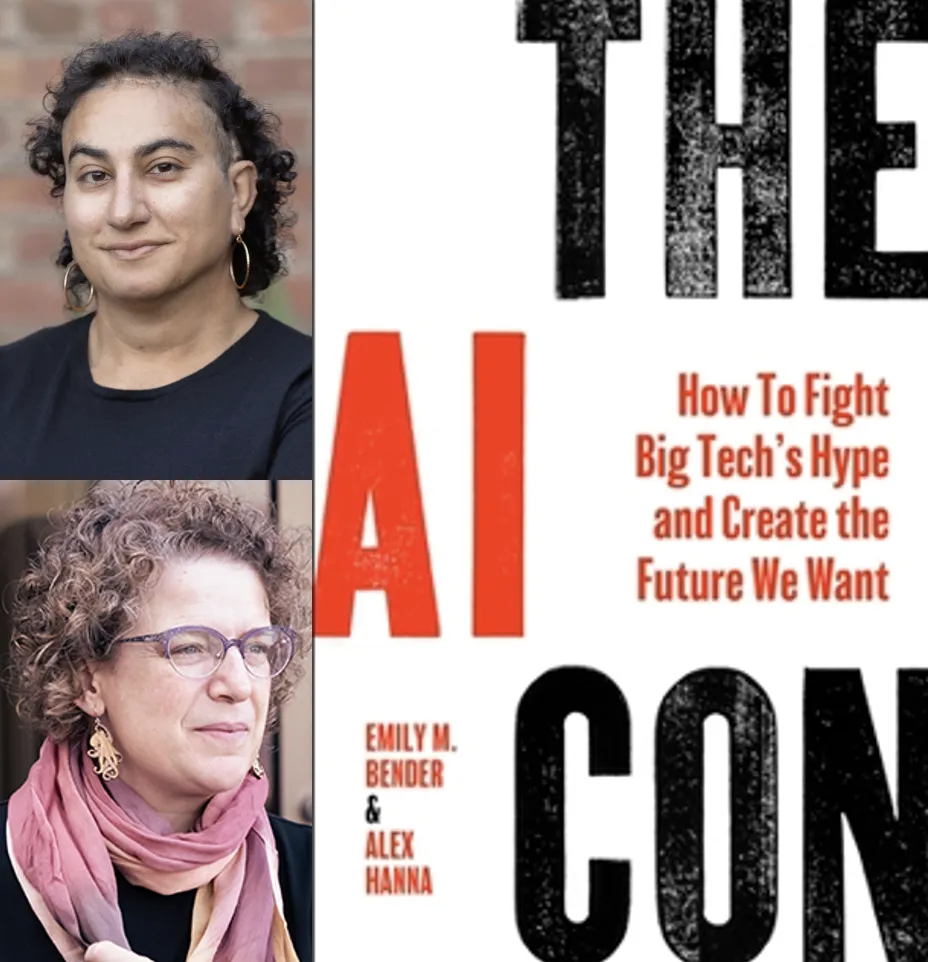
The dialogue is this year's first in the "Critical Perspectives on AI in Education" series.
As the CSU and other universities rush to incorporate generative artificial intelligence into classrooms and workplaces, two prominent critics of the technology told the CSUSB community that its adoption is neither inevitable nor beyond resistance.
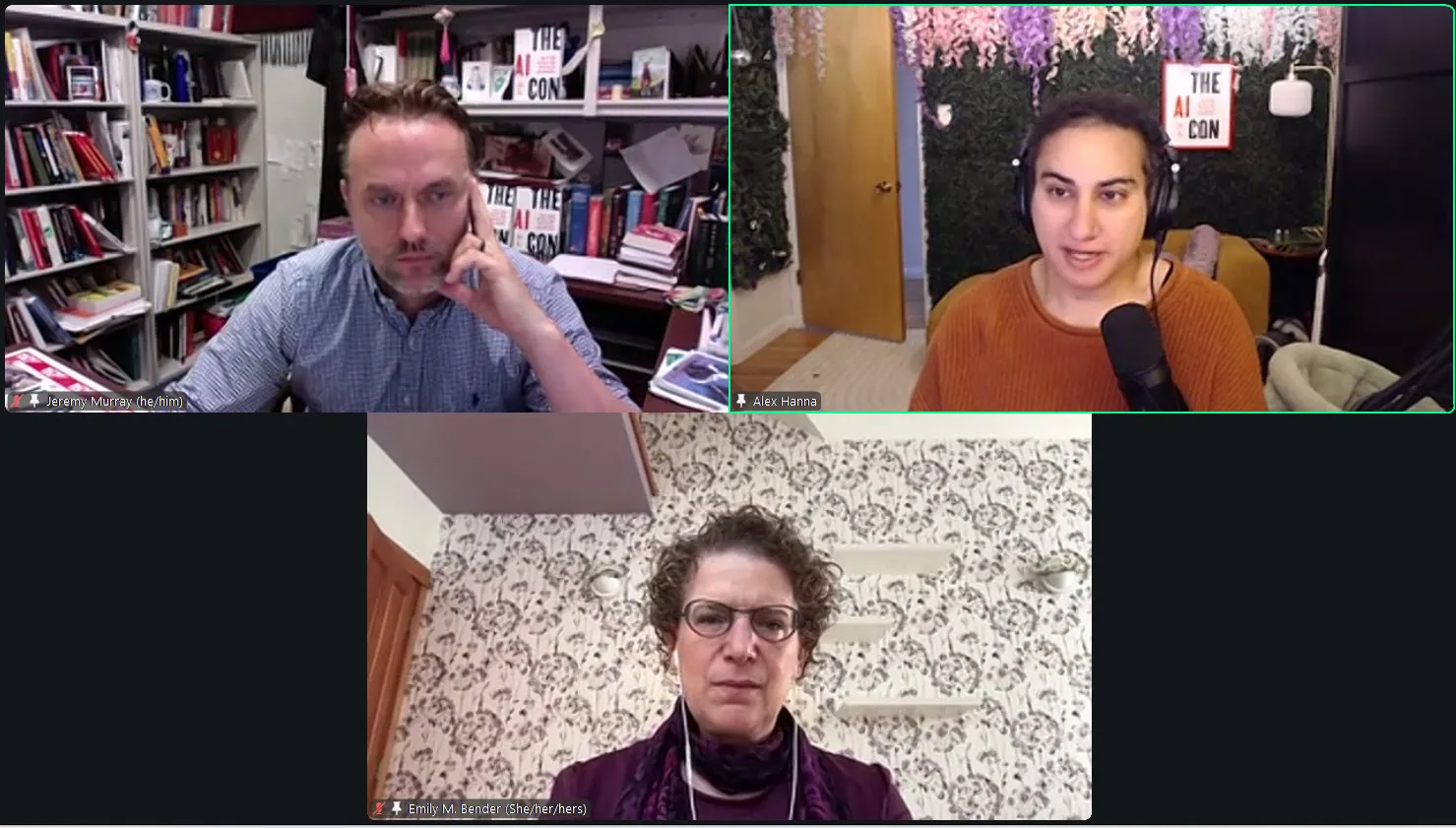
CSUSB professor Jeremy Murray is leading a series of conversations with leading voices in the AI space called “Critical Perspectives on “AI” in Education. On September 14, the first of these series kicked off with “The AI Con”: In Conversation with authors, Drs. Emily Bender and Alex Hanna.
With millions of dollars being invested into ChatGPT for student usage, faculty and students have begun pushing back against the flood of AI generated flyers, lack of clear direction on ethical usage, and seeming inevitability of AI in their education.
There is no responsible or ethical use of these technologies if no isn’t on the table.
This first discussion examined how generative AI is marketed, how large language models (LLMs) work, what effect their adoption is having in labor and educational spaces. Throughout the conversation, Bender and Hanna challenged the idea that students and employees must accept the use of generative AI in their work and schools, simply because their institution has invested time and money into it.
 Stephen Day
This first discussion examined how generative AI is marketed, how large language models (LLMs) work, what effect their adoption is having in labor and educational spaces. Throughout the conversation, Bender and Hanna challenged the idea that students and employees must accept the use of generative AI in their work and schools, simply because their institution has invested time and money into it.
Bender, a professor of Linguistics at the University of Washington, began by talking about the distinction between producing language and understanding it.
LLMs are trained on massive collections of text and learn statistical patterns that help predict how sentences are formed. Bender described them as “systems for outputting plausible-looking text that nobody has accountability for.” However, Bender noted, that doesn’t mean they think, reason, or understand what they are generating.
LLMs take advantage of how humans naturally approach language as communication. When we hear or read a collection of words, Bender explained, we consider what we know about the speaker, who they are speaking to, and whatever specific context surrounds the conversation to infer what the speaker is trying to get across.
We end up applying this same process to generative AI text. “If the output of these systems seems to make sense, it’s because we are making sense of it,” Bender said.
Companies have leaned into this tendency by designing systems that appear conversational and by describing their output with human terms; thinking, knowing, reasoning. Bender showed how that language encourages users to attribute understanding and intent to systems designed only to predict linguistic output.
That same misunderstanding leads them to distort their view on human labor.
“A company or employer that is telling you that they can replace you with a system designed to output plausible-looking text is basically saying, your job is to produce plausible-looking text,” Bender said. “In other words, they have no idea what your job actually is.”
Hanna, director of research at the Distributed AI Research Institute, connected that reductive viewpoint of human labor to the increasing implementation of AI tools and agents in workplaces.
Although backlash surrounding AI may appear to concern the capabilities of the technologies, Hanna said the underlying conflict is frequently about who possesses the authority to determine who does the work, and how that work is performed.
“Even though the fight is about AI, it’s not really about AI, it’s about control in the workplace.”
Hanna offered the example of engineers using LLMs to construct production plans without consulting factory workers. The workers then had to reverse engineer the plans and explain why the proposed components would not function together.
The technology didn’t eliminate the need for workers' expertise, Hanna pointed out, but instead allowed that expertise to be disregarded during the decision making process while leaving workers ultimately responsible for figuring out a solution to correct the results.
The session included a robust and engaging question and answer session, with nearly 50 people in attendance on zoom, in which I took the opportunity to ask what they thought meaningful resistance looked like when employees and students are often not given the choice to use or reject AI usage in their spaces.
Hanna acknowledged that resistance is difficult at the individual level and looked towards union support, worker organizations, and collective action. Employees can also document instances where AI tools do not effectively increase productivity, or create security concerns, so that those claims can be combatted with evidence.
Bender called the claim that AI adoption is inevitable “a bid to steal agency.”
Although the underlying technical developments are not likely to go away, she said, the current level of spending and the effort to place generative AI into every aspect of the work and educational environment are neither economically or environmentally sustainable.
“The easy access to these models and the big push to put them everywhere is in no way inevitable,” Bender said. “Everybody who buys in and spends money on it is helping it along.”
Bender noted that people may not be able to resist in every setting, but visible resistance still matters. She also said another valuable way to push back is to examine whether mandated usages of AI are consistent with the employer’s stated mission and values.
The question of refusal has immediate consequences throughout the California State University system.
During the session, CSUSB professor and Coyote Chronicle advisor, T.C. Corrigan drew attention to the AI protections proposed by the California Faculty Association (CFA) during its ongoing contract negotiations with the CSU. CFA is attempting to incorporate language into their contracts preserving faculty members’ right to use or refuse AI while preventing the technology from replacing, monitoring, or evaluating them.
You can review the June 29th proposal from the CFA here and the counter-proposal from CSU here.
This disagreement reflects a central question raised in the session, who gets to decide whether a technology is introduced to the classroom or the workplace?
Another participant, Chico State staff member Jessi Raeder, said that students have begun asking whether course listings should disclose when AI will be required. Raeder said that she had dropped a course previously after learning that it would require the use of AI.
Bender supported providing students with that information before the class begins. She said that students, faculty members, departments, and institutions should retain the ability to opt out.
The authors also both rejected the idea that students and instructors would be on opposing sides of the issue, with students presumed to be using AI to cheat and faculty members expected to police them.
Hanna pointed to emerging solidarity between students concerned about their intellectual development and instructors concerned about the degradation of education and also the conditions in which they are expected to teach.
Bender said her primary concern as an educator is not catching students who use AI.
“I am far less concerned about students cheating than about what students are getting cheated out of,” she said.
Jessica Luck, chair of the CSUSB English department, questioned whether generative AI should prompt instructors to reconsider how they evaluate student writing. Rather than focusing on grammar, sentence structure, and transitions within an essay, she suggested that educators might place greater value on the content within the essay as evidence of a human mind thinking through a subject.
Bender agreed, saying that she tells her students that she doesn’t expect polished writing and in fact needs to see their writing while it is still developing so that she can be a part of the process of helping them develop and strengthen their own voice.
“I am looking for the opportunity to help you develop your own voice,” Bender said. “That means that I have to see it when it’s rough or I’m not helping. And it has to be your voice.”
The discussion ultimately moved beyond whether generative AI can produce functional text, images, or computer code. Bender and Hanna asked participants to consider what might be lost when institutions treat those visible products as the equivalent to human thought, expertise, and relationships that produced them.
For Hanna, resistance begins by rejecting the assumption that institutions must adopt a single technology simply because companies have declared it to be the future. The more useful question is what would it mean to build technology that genuinely serves the people expected to use it.
For Bender, that process can’t be considered ethical unless refusing the technology remains a legitimate choice.
“The AI Con by Drs. Bender and Hanna is a relevant and lively takedown of “AI” industry hype, which threatens to infest almost every walk of life, including education.” Dr Jeremy Murray via email. “It was a privilege and a thrill to be able to talk with them and share their work with our campus.’
The next event in the ongoing series will again be hosted by Dr. Jeremy Murray on Sept 21st at 12pm PST. “In Conversation with Dr. Lauren Goodlad, Editor in Chief and Co-Founder of journal, Critical AI.” These events are free and open to the public and held over Zoom. More information is available on the Critical Perspectives on “AI” in Education website.